Hello Wordl Gameplay Guide: Clue Colors & Hard Modes
Understanding exactly how Hello Wordl scores each guess turns lucky streaks into repeatable wins across 4 to 11 letter grids. Open another tab to play the Hello Wordl game if you want to test these mechanics step by step on a live grid.
Core Rules: Six Attempts, Any Length From 4 to 11
Every game of Hello Wordl challenges you to deduce a single hidden word within 6 dictionary guesses:
- Choose your word size first: Before submitting row one (or clicking New Game between rounds), move the Letters slider anywhere from 4 to 11. Every size draws from 13,039 everyday recognizable English target words.
- Submit real dictionary words: Every guess must exist inside our 182,721-word dictionary (over 154,000 four-to-eleven letter English words). Invalid character sequences show "Not a valid word" without burning a row.
- Track clues across keyboard and grid: As each row is scored, both the tile grid and the on-screen keyboard update automatically so confirmed letters stand out at a glance.
How Green, Yellow, and Gray Clues Handle Repeated Letters
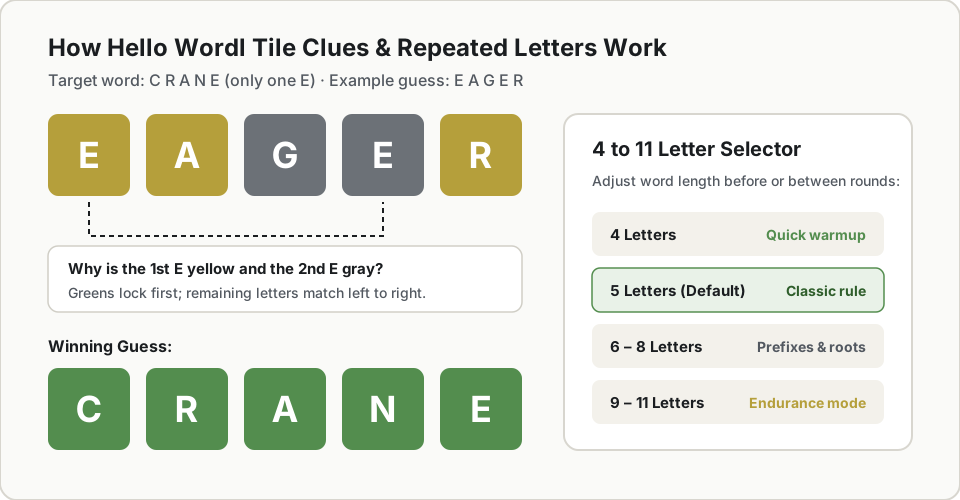
Repeated letters trip up even veteran Hello Wordl players. Seeing a gray E does not guarantee E is absent from the secret word whenever another E in that same guess turned Green or Yellow. Hello Wordl checks each row in two clear steps:
- Step 1 — Lock exact Green matches first: Hello Wordl checks each column from left to right. Anywhere your guessed letter matches the secret word in the exact same position, that tile turns Green and uses up that letter in the answer. Any remaining unmatched letters wait for Step 2.
- Step 2 — Match Yellow clues left to right: Scanning your remaining letters from left to right, Hello Wordl checks if that letter still appears anywhere unmatched in the secret word. If an unmatched copy remains, the tile turns Yellow and claims that copy. When no spare copies remain, any extra repeated letter turns Gray.
Worked Example 1: Secret Word CRANE vs Guess EAGER
CRANEholds just oneEin the fifth spot.- Step 1 finds zero exact position matches, so all five letters (
C, R, A, N, E) stay available for yellow clues. - Step 2 checks left to right: Tile 1 (
E) matches the singleEinCRANE-> Yellow (using up thatE). Tile 2 (A) -> Yellow. Tile 3 (G) -> Gray. Tile 4 (E) has no spareEleft to match -> Gray. Tile 5 (R) -> Yellow. - Deduction: The secret word holds exactly one
E, and it cannot sit in position 1 or position 4!
Worked Example 2: Secret Word ALLEY vs Guess LLAMA
- Step 1 first: Position 2 (
L) matches the second letter ofALLEYexactly, locking Tile 2 Green. Four unmatched target letters remain (A, L, E, Y). - Step 2 left-to-right:
- Tile 1 (
L): Claims the remaining spareL-> Yellow. - Tile 3 (
A): Claims spareA-> Yellow. - Tile 4 (
M): Not in the remaining letters -> Gray. - Tile 5 (
A): Because the onlyAwas already claimed by Tile 3, Tile 5 turns Gray.
- Tile 1 (
Comparing Normal, Hard, and Ultra-Hard ("Wordle Hell")
Clicking ⚙️ Settings lets you escalate difficulty between rounds:
- Normal Mode (Default): Allows any valid dictionary word on every row. This lets you break rhyme-family traps (
LIGHT,MIGHT,NIGHT,RIGHT,SIGHT,TIGHT) by playing a four-consonant eliminator word likeMARTSorCHIMPon Guess 3 instead of gambling 50/50 chances. - Hard Mode: Mirrors strict tournament rules. Confirmed Green tiles must stay locked in those columns, and every Yellow letter seen so far must remain present in your next guess (otherwise the board warns "1st letter must be..." or "Guess must contain..."). Notice the
hellletters in the game header turn crimson. - Ultra-Hard Mode ("Wordle Hell"): Turns the
hellprefix crimson italic and enforces strict logic: Yellow clues cannot stay in the exact column where they just turned yellow ("2nd letter can't be E"), and whenever a gray duplicate reveals the exact count of a letter in the target (such as zero copies, or exact copy cap like the grayEinEAGER), subsequent guesses must obey that exact count ("Guess can't contain...").
Common Beginner Mistakes to Avoid in Hello Wordl
- Ignoring gray duplicates: Whenever a second
EorTturns gray alongside a yellow/green copy, mark mentally that the target contains no additional copy. - Repeating dead letters in Normal mode: Keeping previously grayed letters in Guess 2 wastes valuable information slots when alternative words test four or five fresh consonants.
- Forgetting Give Up doesn't freeze the game: Stumped on a tricky 10-letter round? After Guess 1, tapping Give up shows the exact answer cleanly so you learn the word before starting fresh.
Combine these rules with statistical openers in Best Hello Wordl Starting Words, dive deeper into Double Letters & Ultra-Hard Mode Strategy, or switch over to synchronized rounds in Daily Seed Mode.